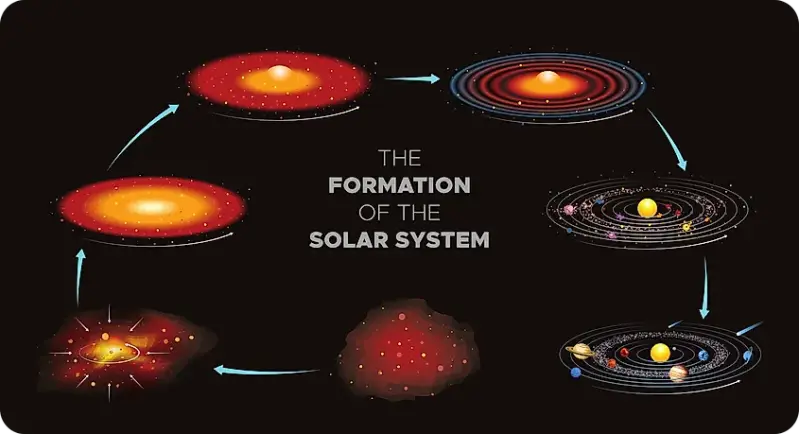
Currently, one of the most commonly accepted theories as to the origin of our solar system is this (chronologically ordered):
1. a "big bang" expansion of protoplasmic phenomena (primal energy, particles)
2. coalescence of this cosmic "soup" into stars because of gravity during some thousands, millions, billions of years (approximately)
3. remnant gas and dust of supernova star explosions reforming into planets and moons (purportedly caused by a rarer type of collapse after initial formations)
4. abiogenesis, life beginning amidst, with, inanimate matter upon Gaia* and perhaps plausibly elsewhere, 'elsewhen'
* "Gaia is a beautiful name of Greek origin for these earths and waters. In Greek mythology, Gaia, known as the mother goddess, was the personification of the Earth. She is described as a caring and nurturing figure to all the children and plants of the world." (Thanks, Google.)
Evidence for all of the above, "The Big Bang Theory", includes:
-
the supposed "red shift" of galaxies, a phenomenon observed thanks to the Hubble space telescope
-
same fossil remains on such as the east coast of South America and the west coast of Africa indicating "Pangea" / "Gondwana" existed, all continents together as a supercontinent, during ancient epochs of time
-
(apparent) remnants of supernova explosions


"WASP-39b's atmospheric transmission spectrum captured by Webb’s Near-Infrared Spectrograph (NIRSpec) reveals first clear evidence for carbon dioxide in a planet outside the Solar System."
(WASP-39b - Wikipedia)

According to a video lecture by a professor I saw upon the topic of abiogenesis, approximately 10^55 (a one with fifty-five zeros after it, plus or minus some orders of magnitude perhaps) combinations of chemicals, substances, existed on early Earth (~1B years old) which yielded the basics of life.
Eventually the thousands of types of species came to be upon Gaia, this planet, over eons.
Plausible-to-me dangers to the continued existence of life like we know it include:
-
rogue black holes
-
large asteroids
-
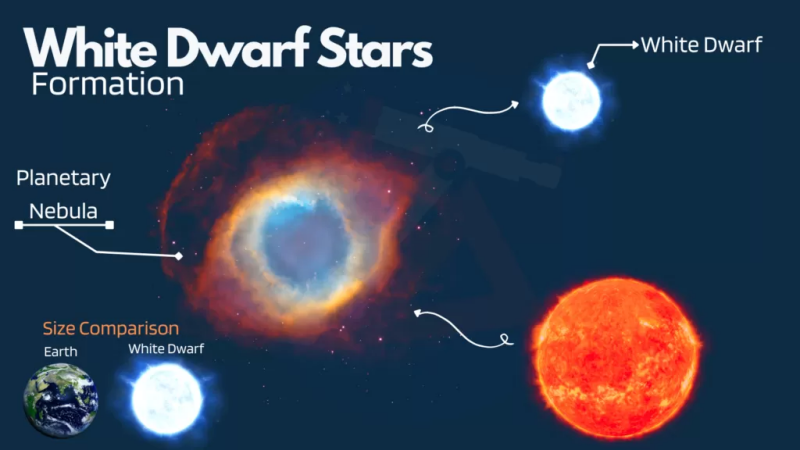
large ejections such as planetoids and neutron / dwarf stars (image below from White Dwarf Stars எவ்வாறு உருவாகின்றன? - Tamil Astronomy) black hole collisions
We might lack the ability to stop such things if very large and--or dangerous.
I hope these risks are negligible (or erroneous) and we are robustly, fortunately, luckily safe amidst known galaxies, this vast cosmos.